
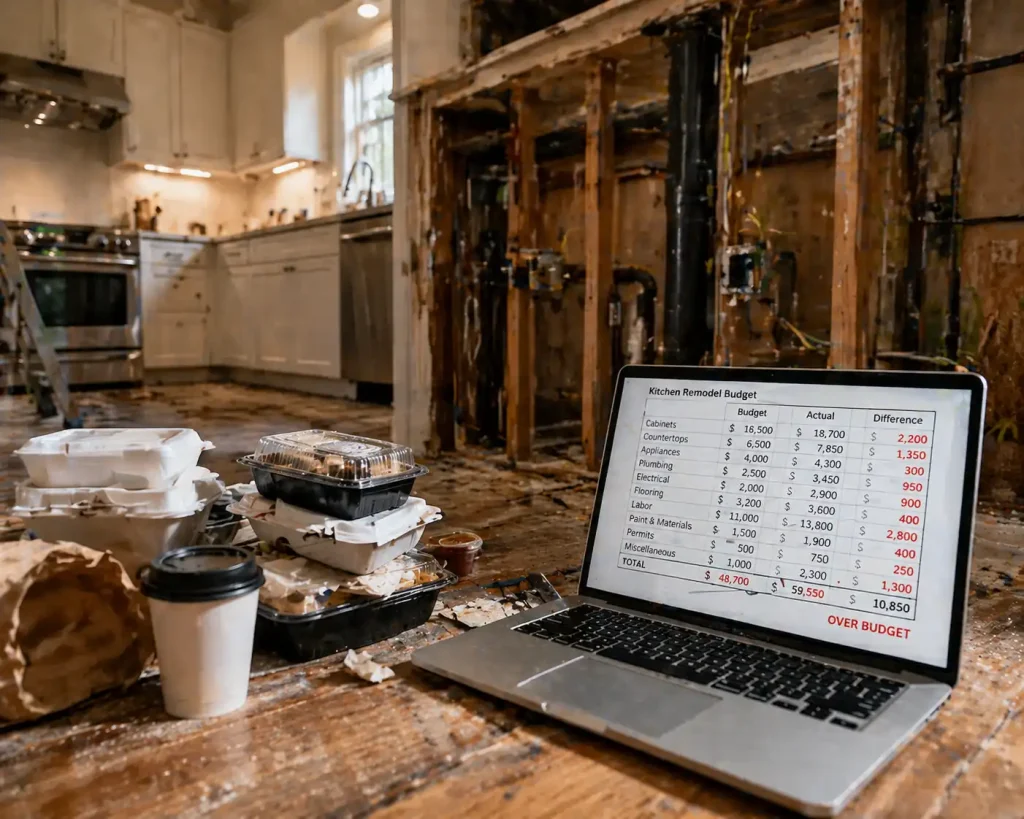
The contractor’s bid says $58,000. You sign, you write the deposit check, you start picking out cabinet hardware. Six months later you have spent $74,000. Where did the extra $16,000 go?
Almost never on the things you would expect. The big-line items in a kitchen remodel are usually predictable. It is the small, recurring, easy-to-overlook costs that pile up. Knowing them in advance is the difference between sticking to budget and hating your remodel by month four.
The “while we are in there” trap
Walls open up. The plumber points out the cast iron drain stack from 1962. The electrician notices the panel does not have room for the new circuits the cooktop and oven need. The HVAC contractor mentions the duct routing is going to be ugly without reframing.
Each of these decisions costs $800 to $5,000. Each one feels rational in the moment because the wall is open right now and access will never be cheaper. By the time the project is done, $10,000 to $15,000 in “while we are in there” upgrades is normal on a mid-size remodel. Build a contingency line of 15 percent of the total budget specifically for these calls. Mapping these decisions onto a step-by-step kitchen renovation timeline helps you decide which add-ons are worth it and which can wait.
Disposal and dumpster fees
Old cabinets, countertops, drywall, flooring, appliances. The dumpster rental, disposal fees, and labor to load it all out can run $1,500 to $4,000 on a full remodel. Most contractors include this in the bid. Some do not. Read the contract carefully.
If your old countertop is granite or quartz, expect a higher disposal fee. Stone weighs hundreds of pounds and most landfills charge by weight.
The temporary kitchen
You are losing your kitchen for six to twelve weeks. You will need somewhere to make coffee, store food, wash dishes, and feed the family. Get a realistic sense of how long a kitchen remodel actually takes before you build your temporary setup.
A temporary kitchen typically includes a folding table or workbench, a microwave, a hot plate or induction burner, a mini-fridge or use of the basement fridge, paper plates and disposable utensils, a slow cooker, plastic bins for food storage, and a wash station built off the laundry sink or bathtub.
Budget $300 to $700 for the gear, assuming you do not already own a hot plate, slow cooker, and microwave.
The eating-out budget blow
Even with a temporary kitchen, you will eat out more. Way more. A family of four ordering takeout three or four nights a week for two months adds $1,200 to $3,000 to the project’s true cost.
You can soften this by meal-prepping freezer dinners before demo, but most homeowners under-prep. Plan for the food cost. It is real money.
Permits, inspections, and code-required work
Permit fees in Columbus run a few hundred dollars for a typical kitchen remodel. That part is small. The expensive part is what inspectors require once the walls are open. This is one of many reasons working with a licensed Columbus contractor matters more than the cheaper bid from someone unlicensed.
Hardwired smoke and CO detectors in adjacent rooms. GFCI and AFCI outlets that did not exist before. A whole-house water shutoff if your existing one is buried. Insulation upgrades to current code. Each one is small. Together, they can add $1,500 to $3,500.
This is not the contractor padding the bill. It is the city saying you cannot reclose the wall without bringing things up to current code.
Electrical and plumbing surprises
Older Columbus homes, especially anything built before 1970, have wiring and plumbing that does not meet current code. Knob-and-tube, ungrounded outlets, undersized service panels, galvanized supply lines, cast iron drains.
When the walls open, these get exposed. Bringing the kitchen circuits up to code can run $2,000 to $6,000. Replacing a section of drain stack might add $1,500. None of this shows up in the original bid because no one knew until demo started.
If you live in a pre-1970 home, set aside another 5 percent of budget specifically for old-house surprises.
Restocking the pantry
Once the new kitchen is in, the pantry comes back stocked. Spices, oils, baking supplies, snacks. A lot of it had been thrown out, given away, or used up during the remodel. Restocking a typical family pantry runs $200 to $500.
Same goes for cleaning supplies, dish soap, paper towels, and the small stuff that quietly disappeared during the chaos.
The cleaning bill
Construction dust gets everywhere. Inside cabinets two floors away. Inside the HVAC system. On every flat surface in the house. Even good contractors who clean up daily do not catch it all.
A post-construction deep clean from a professional service in Columbus runs $300 to $700 depending on house size. Worth every dollar. Doing it yourself is a weekend you will not get back.
The buffer rule
Take the bid. Add 15 percent for the “while we are in there” decisions. Add another 5 to 7 percent if you are in an older home. Add $2,000 to $4,000 for soft costs like food, temporary kitchen, cleaning, and pantry restock. Reading up on common kitchen remodel mistakes to avoid can also help you spot budget traps before they hit.
That number is your real budget. If you cannot afford the real number, you cannot afford the project. Better to know that before demo day than during it.
The bottom line
Hidden kitchen remodel costs are not really hidden. They are just not on the contractor’s bid because no one can predict them with full accuracy until work begins. The homeowners who finish on budget are the ones who built a buffer in from day one.
Sign the contract knowing your real number, not the optimistic one. Then the surprises stay manageable instead of becoming the reason the project goes sideways.