
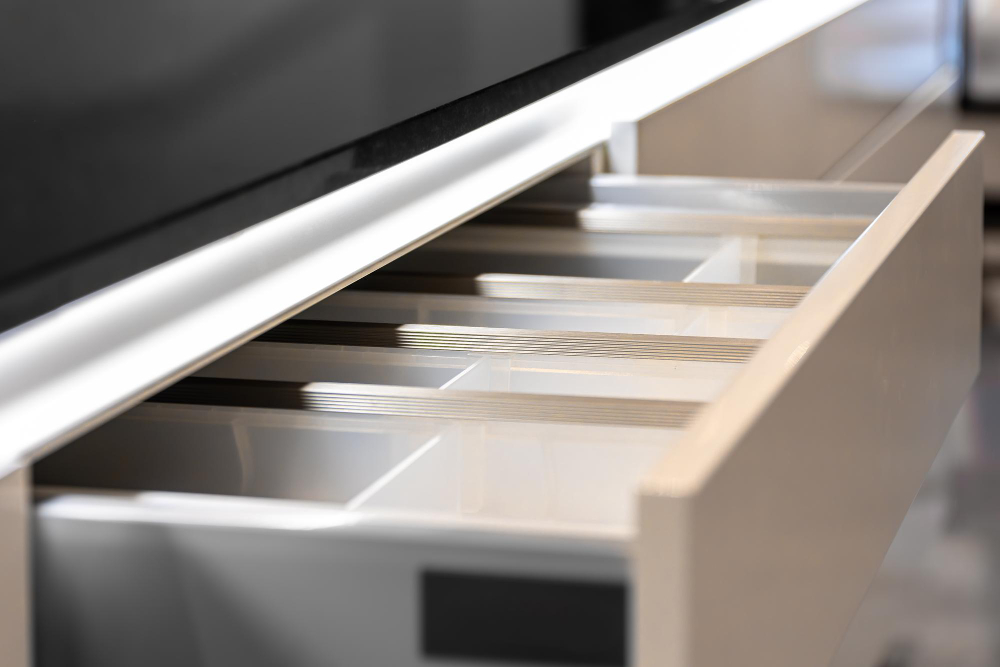
Cabinet filler strips do not get much attention during a kitchen remodel, but they solve a problem that comes up in nearly every cabinet installation. If you have ever noticed a narrow piece of wood between a cabinet and a wall, or between two cabinets that do not line up flush, that is a filler strip doing its job.
Here is a closer look at what cabinet filler strips are, where they get used, and why they matter more than most homeowners realize.
What Is a Cabinet Filler Strip
A cabinet filler strip is a narrow piece of wood used to fill a gap between a cabinet and a wall, between two adjacent cabinets, or between a cabinet and an appliance. They are typically made from the same material and finish as the surrounding cabinetry, which allows them to match the rest of the installation and give the kitchen a consistent finished look.
Filler strips come in different widths depending on the gap they need to cover. Standard sizes generally range from about one inch to six inches, though custom widths are also available when a gap falls outside those standard dimensions.
Why Gaps Exist in Kitchen Cabinets
Kitchen walls are rarely straight or plumb. Over time, homes settle and walls shift, and even new construction rarely produces wall surfaces that are exact. When cabinets are installed against a wall that has any variation in its surface, a gap can appear between the edge of the cabinet and the wall.
Gaps also appear when a kitchen layout calls for cabinets to be placed at a specific distance from an appliance or another cabinet, and the available space does not divide evenly into standard cabinet sizes. Cabinet manufacturers produce a set range of widths, and filling the leftover space is where filler strips come in.
Where Cabinet Filler Strips Are Used
Between a Cabinet & a Wall
This is the most common application. When a run of cabinets meets a wall at the end, there is often a small gap between the cabinet face frame and the wall surface. A filler strip bridges that gap and gives the installation a finished look. It also prevents items from falling into the space behind the cabinet where they would be difficult to retrieve.
Between Two Cabinets With a Clearance Issue
In some kitchen layouts, two cabinets are placed next to each other in a way that would cause the doors or drawers to interfere with each other when opened. Adding a filler strip between the two cabinets creates enough clearance for each door or drawer to open fully without catching on the adjacent unit.
Next to Appliances
Gaps between cabinets and appliances like dishwashers, refrigerators, or ranges are another common use case. A filler strip in these locations protects the cabinet edge from moisture or heat exposure and gives the area a more finished appearance.
At Inside Corners
When two runs of cabinets meet at an inside corner, clearance is often needed for drawer pulls or door handles to clear the adjacent cabinet. A filler strip in the corner provides that clearance and allows the cabinets to function as intended.
Why Filler Strips Matter in Kitchen Design
They Protect the Cabinet
Without a filler strip next to a wall, the edge of the cabinet frame sits exposed. Walls collect moisture, grease, and dirt over time, and that sustained contact can wear down the edge of a cabinet. A filler strip creates a buffer between the cabinet and the wall.
They Allow Full Functionality
Cabinet doors and drawers need clearance to open properly. When cabinets are installed too close to a wall or to each other, hardware catches and doors do not open to their full range. Filler strips prevent that problem by providing the space needed for full movement.
They Give the Kitchen a Finished Look
A gap between a cabinet and a wall draws the eye, even a small one. A properly fitted filler strip closes that gap in a way that looks intentional and consistent with the surrounding cabinetry. Most homeowners never notice a well-installed filler strip, which is exactly the point.
Custom vs Standard Filler Strips
Standard filler strips align with the most common cabinet sizing increments. When a gap falls outside those standard dimensions, a custom filler strip is cut to the specific width needed.
Custom filler strips are common in kitchens with irregular wall layouts, older homes where walls have shifted over time, or higher-end kitchen designs where fit and finish standards are more demanding. In those cases, the installer takes precise measurements and cuts the strip accordingly.
Getting Filler Strips Right During Installation
Filler strips need to be scribed correctly to the wall surface. Scribing means tracing the profile of the wall onto the strip and cutting along that line so the piece fits the wall exactly, even if the wall surface is not straight. A poorly fitted filler strip will have visible gaps along the wall edge that look unfinished and can allow moisture or debris to collect behind it.
This is one of the details that separates a careful cabinet installation from one that looks rushed. When filler strips are scribed and fit correctly, the result is a kitchen that looks like it was built specifically for the space, because in a meaningful way, it was.