
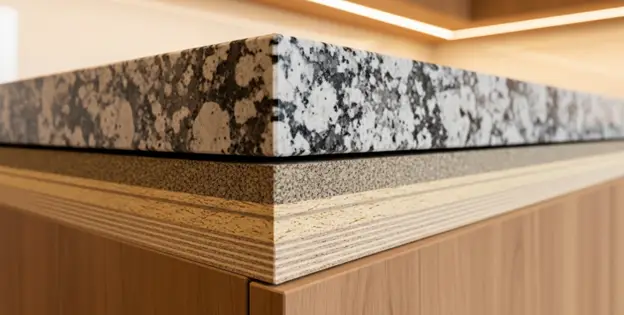
Granite countertops are a staple in modern kitchens, known for their durability, elegance, and timeless appeal. One of the most common questions homeowners and designers ask is: how thick is granite kitchen counter? The thickness of your granite not only affects its appearance but also its structural integrity, durability, and cost. In this complete guide, we’ll explore standard granite countertop thicknesses, how to choose the right option for your kitchen, and everything in between.
Short Answer — How Thick Is Granite Kitchen Counter?
The standard thickness of a granite kitchen counter generally falls into two primary categories: 2 cm (¾ inch) and 3 cm (1¼ inch). These measurements refer to the actual depth of the granite slab from top to bottom.
- 2 cm granite countertops are slightly thinner and lighter, often used in kitchens with budget constraints or where additional support is available.
- 3 cm granite countertops are thicker, stronger, and the most popular choice for modern kitchens because they provide better durability and a luxury appearance without requiring extra support.
Why Thickness Matters
Granite thickness directly impacts:
- Durability – Thicker slabs resist cracking and chipping better.
- Installation – Heavier slabs may require stronger cabinets and support structures.
- Design – The thickness influences edge profiles, overhangs, and overall visual appeal.
Standard Thickness of a Granite Kitchen Counter
2 cm Granite Countertops
2 cm granite slabs are approximately ¾ inch thick. They are lighter, easier to handle, and usually less expensive. However, when answering how thick is granite kitchen counter, it’s important to note that 2 cm granite often requires plywood or additional support under the cabinets to ensure stability, according to recommendations from The Kitchen Consultants.
3 cm Granite Countertops
3 cm granite slabs are about 1¼ inch thick and have become the standard in most residential and luxury kitchens. Their weight provides natural stability, eliminating the need for extra plywood support. They also accommodate a wider variety of edge profiles and overhang designs.
Core Explanation: While 2 cm granite works for smaller installations, 3 cm granite offers superior strength, durability, and design flexibility, which explains why it dominates the market today.
Understanding Granite Countertop Thickness in Modern Kitchens
Granite countertop thickness isn’t just about measurements; it’s a key factor in the slab’s performance and longevity.
What Granite Slab Thickness Means
Granite is quarried in massive blocks and then cut into slabs of uniform thickness. The thickness of these slabs determines how well the countertop will handle daily wear, weight, and environmental stress.
How Granite Slabs Are Cut
- From Quarries – Giant blocks are extracted and sliced using diamond-wire saws.
- Polishing and Finishing – The slabs are polished to enhance color and sheen.
- Sizing for Kitchens – Standard residential thicknesses are cut as 2 cm or 3 cm for practical handling and installation.
How Thickness Impacts Strength and Durability
Thicker granite is naturally more resilient. Here’s why:
- Structural Integrity – A thicker slab distributes weight more evenly.
- Crack Resistance – Thicker slabs are less prone to breaking under pressure or impact.
- Weight Support – 3 cm granite can handle heavy appliances and large overhangs without extra bracing.
How Thickness Affects Kitchen Design and Appearance
The visual and functional aspects of a kitchen are also influenced by granite thickness:
- Edge Profiles – Certain edges, like full bullnose or waterfall edges, require 3 cm slabs to achieve a seamless look.
- Luxury vs Basic Look – Thicker slabs convey a premium appearance, whereas thinner granite is often layered for a similar effect.
- Modern vs Traditional Kitchens – 3 cm granite fits both modern minimalist designs and classic kitchens, while 2 cm granite is often chosen for secondary surfaces or budget-friendly renovations.
Granite Countertop Thickness Comparison Table
| Thickness Measurement | Weight | Strength | Installation | Style | Best For |
| 2 cm Granite | ~¾ inch | Lighter | Moderate – Needs plywood support | Budget-friendly | Small kitchens, secondary surfaces |
| 3 cm Granite | ~1¼ inch | Heavier | Strong – No plywood needed | Modern and luxury look | Most residential kitchens |
| Laminated Edge Granite | Custom | Very strong | Decorative build-up | Luxury designs | High-end kitchens with custom edges |
2 cm vs 3 cm Granite Countertops
- Cost Differences: 2 cm granite is generally cheaper, both in material and installation costs.
- Structural Differences: 3 cm granite provides superior strength and allows for larger overhangs.
- Popularity in US Kitchens: 3 cm is widely preferred for its durability and premium feel.
Why Granite Countertop Thickness Matters
Granite thickness affects multiple aspects of your kitchen:
- Structural Support – Ensures slabs do not sag or crack.
- Edge Profile Options – Determines which edge styles are feasible.
- Installation Complexity – Thicker slabs are heavier and require professional handling.
- Cabinet Compatibility – Cabinets must support the slab weight.
Does Thicker Granite Last Longer?
Yes. 3 cm granite resists chipping, cracking, and warping better than 2 cm slabs, making it ideal for long-term durability.
Can Thin Granite Crack Easily?
Thin granite (2 cm) can crack if improperly supported or subjected to heavy impact, particularly on large islands or overhangs.
Do Thicker Granite Countertops Cost More?
Yes. Material costs, fabrication, and installation fees increase with thickness. However, the added durability often justifies the expense.
Guide to Choosing the Right Granite Countertop Thickness
Step 1 — Measure Your Kitchen Cabinets
Ensure your cabinets can handle the granite slab weight. Standard 3 cm granite weighs roughly 18–20 lbs per square foot.
Step 2 — Consider Overhang Requirements
- Bar Seating – Maximum overhang without support: ~12 inches for 3 cm granite.
- Kitchen Island – Overhangs beyond 10–12 inches often need brackets or corbels.
Step 3 — Choose an Edge Profile
- Beveled – Subtle, classic edges work with both thicknesses.
- Ogee/Bullnose – Require 3 cm slabs for a full, natural look.
- Waterfall Edges – Only feasible with 3 cm granite.
Step 4 — Evaluate Budget vs Durability
Balance cost constraints with long-term performance. Thin granite is cheaper but less durable; thick granite is an investment.
Step 5 — Consult With a Fabricator
Professional insight ensures proper slab selection, cutting, and installation.
Granite Countertop Edge Profiles and Their Thickness Requirements
Edge Profiles That Work Best With 3 cm Granite
- Full bullnose
- Ogee edge
- Waterfall edge
Edge Profiles Used With 2 cm Granite
- Laminated edge build-up
- Mitered edges
Edge profile choice can affect the visual impact and structural requirements of your countertop.
Ideal Granite Thickness for Different Kitchen Layouts
Granite Thickness for Kitchen Islands
3 cm is preferred for islands with heavy overhangs and high usage.
Granite Thickness for Bathroom Vanities
2 cm is often sufficient for smaller vanities without heavy appliances.
Granite Thickness for Outdoor Kitchens
3 cm or custom thicker slabs are recommended due to exposure to temperature fluctuations.
Structural Support Requirements for Granite Countertops
Cabinet Support Guidelines
- Use solid wood cabinets for 3 cm granite.
- Particleboard or MDF may need reinforcement for 2 cm granite.
When Plywood Subtops Are Required
Thin granite (2 cm) often requires plywood or additional sub-support to prevent flexing.
Overhang Support Brackets Explained
Brackets or corbels provide extra stability for extended overhangs, especially with 2 cm slabs.
How Granite Thickness Affects Countertop Cost
Average Price of 2 cm Granite Countertops
- Lower material cost
- Requires support installation, which adds to labor costs
Average Price of 3 cm Granite Countertops
- Higher material cost but simpler installation
- No plywood needed, reducing labor
Fabrication and Installation Cost Differences
Thicker slabs are easier to fabricate for certain edges, but shipping and handling are heavier.
Common Mistakes When Choosing Granite Countertop Thickness
Choosing Thin Granite for Large Islands
Thin slabs can sag or crack under heavy use.
Ignoring Cabinet Strength
Cabinets must be able to support slab weight to prevent long-term damage.
Overlooking Edge Profile Compatibility
Certain edges require thicker slabs for durability and aesthetic appeal.
FAQs About Granite Countertop Thickness
How thick is a standard granite kitchen countertop?
Most standard countertops are 2 cm or 3 cm thick, with 3 cm being more common.
Is 2 cm granite strong enough for kitchen counters?
Yes, for small surfaces or with proper support, but less ideal for islands or heavy use areas.
Is 3 cm granite better than 2 cm granite?
Yes, it’s stronger, more durable, and supports a wider variety of edges.
Do granite countertops need plywood support?
2 cm granite often requires plywood; 3 cm usually does not.
How thick should granite be for a kitchen island?
3 cm is recommended for islands, especially with overhangs.
What thickness granite is used in luxury kitchens?
3 cm or thicker, sometimes custom laminated edges for added visual weight.
Can you make granite countertops thicker with edges?
Yes, laminated or mitered edges can add visual thickness to 2 cm slabs.
How heavy is a granite countertop slab?
- 2 cm: ~12–15 lbs per square foot
- 3 cm: ~18–20 lbs per square foot
Final Thoughts on How Thick Granite Kitchen Counters Should Be
Choosing the right granite countertop thickness is essential for durability, design, and long-term satisfaction in any custom kitchen remodel. While 2 cm granite works for smaller or budget-conscious kitchens, 3 cm is the most common and recommended choice for most homeowners. It supports modern edge profiles, large islands, and heavy use without additional reinforcement. When planning a custom kitchen remodel, consider your kitchen layout, cabinet support, and design goals before making a decision. Ultimately, the right thickness ensures your granite countertop remains both beautiful and functional for decades.