
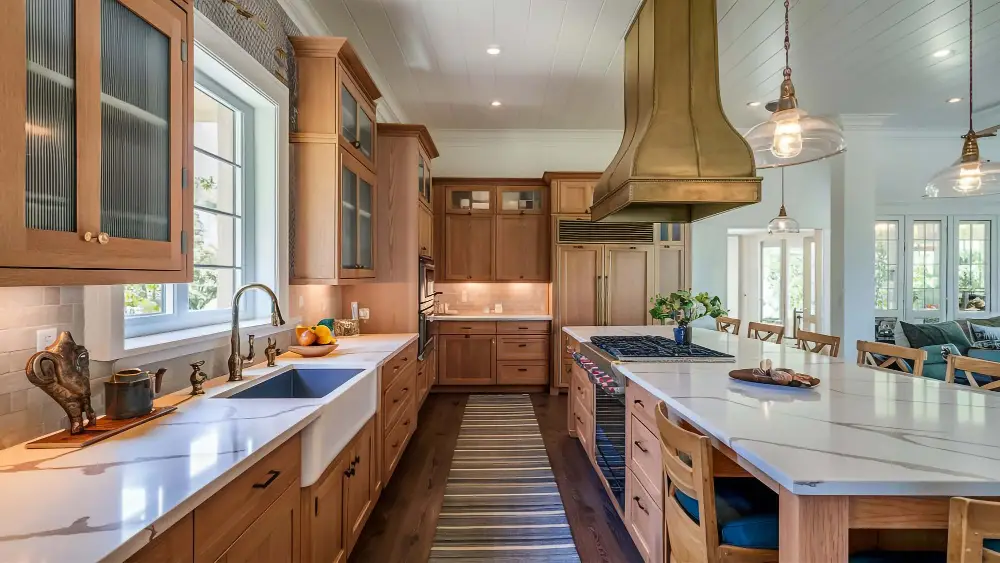
The galley kitchen is one of the most efficient layouts ever designed for cooking. Two parallel runs of cabinets and countertops with a single corridor between them puts everything within arm’s reach and keeps traffic moving in one direction. It works. The problem is that galley kitchens are also one of the more expensive layouts to renovate relative to their square footage, and most homeowners don’t see that coming until they’re already deep into the planning process.
The reason comes down to how much is packed into a small space. Every linear foot of a galley kitchen has cabinets above, cabinets below, countertops, backsplash, and usually appliances on both walls. When you renovate a galley, you’re touching all of it. There’s no open wall to skip, no corner to leave alone. The cost per square foot in a galley renovation tends to run higher than an open-concept kitchen of the same total square footage.
Here’s a realistic breakdown of what a galley kitchen remodel costs and where that money goes.
What Drives the Cost of a Galley Remodel
Linear Footage Is Everything
Galley kitchens are priced almost entirely by the linear foot of cabinetry and countertop rather than by total room area. A galley that’s eight feet long on each wall has sixteen linear feet of cabinet runs. A galley that’s twelve feet long on each wall has twenty-four linear feet. That difference adds up fast when you’re pricing cabinets, countertops, and backsplash tile.
The corridor width also matters. Building codes typically require a minimum of 36 inches of clearance between facing countertops in a galley kitchen. Most remodels aim for 42 to 48 inches when the footprint allows it, because the extra clearance makes the kitchen noticeably more comfortable to work in. If a wall needs to move to achieve that clearance, that adds to the cost.
Appliance Placement Complications
Galley kitchens frequently have appliances split between both walls, which means plumbing and electrical connections exist on both sides of the room. Relocating a sink or moving a range from one wall to the other requires rerouting plumbing or electrical runs that may need to travel across the floor or through walls in ways that add both labor and material cost. Keeping appliances in their existing locations saves money. Moving them costs more in a galley than it does in a kitchen with a single primary wall.
Cost Tiers for a Galley Kitchen Remodel
Entry-Level Galley Remodel: $15,000 to $30,000
At this range, the project typically keeps the existing layout intact and focuses on replacing what’s most visible. Stock or value-priced semi-custom cabinets, a mid-range countertop surface like quartz or butcher block, new hardware, updated lighting, and a basic backsplash are the core of an entry-level galley remodel. Appliances may be refreshed or left in place depending on their condition.
This tier works well when the existing plumbing and electrical are in good condition and the layout doesn’t need to change. The finished result looks significantly different from the starting point without requiring structural work or a complete gut renovation.
Mid-Range Galley Remodel: $30,000 to $55,000
The mid-range expands the scope to include semi-custom cabinetry with interior organization systems, a quality countertop surface, recessed lighting, under-cabinet lighting, updated plumbing fixtures, and appliance replacements. At this level, minor layout adjustments may be included, such as relocating the sink to a window wall or adjusting where appliances sit to improve workflow.
New flooring is also typically part of a mid-range galley remodel, either hardwood, tile, or luxury vinyl plank depending on what’s already in the adjacent rooms. Electrical updates, including adding circuits for new appliances, fall into this tier as well.
High-End Galley Remodel: $55,000 & Up
High-end galley remodels involve custom cabinetry, premium countertop materials like quartzite or high-grade granite, panel-ready appliances, a full lighting plan, and in some cases structural changes to open one end of the galley into an adjacent room. This last move, removing the wall at one end of the corridor to connect the galley to a dining or living space, is one of the most impactful changes possible in a galley kitchen because it resolves the closed-in feeling that makes some homeowners want to avoid the layout altogether.
Where Galley Remodel Costs Tend to Surprise Homeowners
The Backsplash Runs the Entire Length
In a galley kitchen, backsplash tile covers both walls from counter to upper cabinet on both sides of the room. That’s a lot of tile relative to the square footage of the kitchen itself. Labor for backsplash installation in a galley is also more involved than in an open-concept kitchen because of the cuts required around outlets, windows, and appliances on both walls.
Lighting Requires More Planning
Galley kitchens have limited ceiling area relative to the amount of counter space below. Getting the lighting right means planning recessed fixtures carefully so that both work surfaces are covered, and adding under-cabinet lighting on both sides of the corridor. That doubles the under-cabinet lighting cost compared to a single-wall layout.
Flooring Transitions Matter
Galley kitchens often connect to adjacent rooms at both ends, which means flooring transitions at two points instead of one. If the flooring in the galley is being replaced and the adjacent room floors are staying, those transitions need to be handled cleanly, which adds a small but real cost to the flooring scope.
Getting an Accurate Number for Your Galley Project
The only way to get a number that means anything is to have a contractor walk the space, measure the linear footage of cabinetry, assess the condition of the existing plumbing and electrical, and understand what the layout goals are. Galley kitchens vary enough in their specific configurations that ballpark figures from the internet can be off by a significant margin in either direction. A proper in-home assessment gives you a number you can actually plan around.